Daily fantasy pick ’em apps like PrizePicks and Underdog Fantasy look effortless: pick a few players, stack a multiplier, cash if you run pure. That simplicity is a feature — and also the trap. Under the hood, how you structure the slip (power vs flex, insured vs non-insured, leg count) changes the implied odds per leg as much as your player research does. This guide condenses our YouTube breakdown: payout math, book-by-book differences, and how SharpMoney DFS ties it together.
Watch the Full Video
Walkthrough of PrizePicks vs Underdog payout math, the SharpMoney DFS tool, slip building, and filters.
Open on YouTube → · Check the description for YouTube10 (10% off your first month where applicable) and links to SharpMoney pricing.
Why the UI Feels Like an Arcade (and Why That Masks the Math)
Pick ’em products lean into props, parlays, and multipliers. They are real-money markets with different payout physics than a straight bet at a sportsbook: boosted lines, discounted legs, flex vs power (or insured vs non-insured), and cross-slip multipliers can all change the effective price of the same prop. Most of the house edge isn't only "bettors pick badly" — it's bettors building the wrong structure for the prices they pay per leg.
Power Play vs Flex (PrizePicks) — Same Picks, Different Economics
- Power play (all legs must hit): classic parlay. One miss and the slip is dead; multipliers are higher when you nail every leg.
- Flex play: you trade top-end payout for partial credit when one or more legs miss (e.g. hit five of six and still get paid).
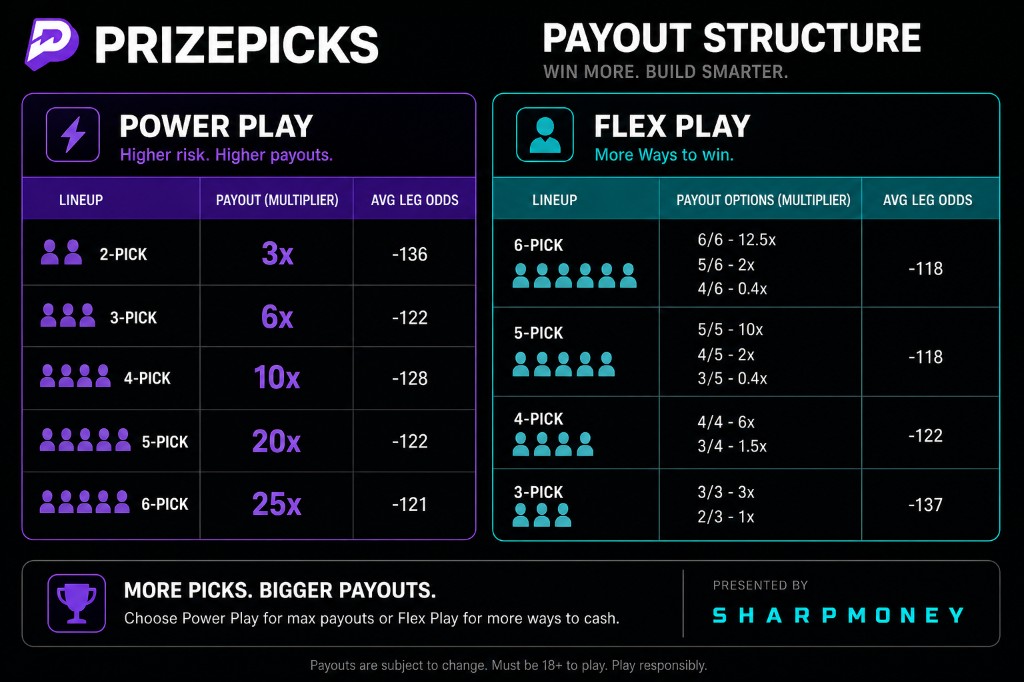
On a six-pick example from the walkthrough: a straight power structure might top out around 25x when all six hit, while the six-pick flex pays a smaller maximum when you sweep but pays something on five of six (e.g. roughly double) or four of six (e.g. roughly 4x stake back in the table shown). The exact numbers on your screen are the source of truth — the lesson is: flex is insurance; insurance has a cost in upside.
PrizePicks payout structure (reference)
Official multipliers and average leg odds move over time; this SharpMoney graphic matches the structure discussed in the video. Always confirm in-app before you lock a slip.
Average Leg Odds: The Number Sharp Bettors Actually Use
Multipliers are flashy; average implied odds per leg is comparable to what you already know from American odds at a book. Roughly: the tighter the average juice per leg (e.g. closer to −115 than −150), the easier it is for an edge to survive variance long term. That's why two-pick ladders that "feel easy" can still be -EV if each leg is priced like a heavy favorite — you need either an enormous edge per leg or a structure that returns better average leg prices.
PrizePicks: What to Build (and What to Avoid)
From the breakdown:
- Favored structures: Five- or six-pick flex — in the table discussed, average leg odds landed around −118, among the softer structural prices on the board.
- Acceptable power: Three-pick power at roughly −122 average per leg if you only have a handful of strong legs and need an all-or-nothing ticket.
- Usually avoid: Two-pick power — high hit rate, but the payout is often so poor that you need unreal edges on both legs to overcome the structure.
If you only see one or two +EV props, the answer isn't always "force a two-pick"; it's often "wait for more legs," shift to a better leg-count tier, or use a different book whose payout ladder fits that slip size.
Underdog: The Ladder Is Different (and That Changes Everything)
Underdog labels the same idea non-insured (≈ power) vs insured (≈ flex). The surprise in the video: PrizePicks' worst tier can be Underdog's best.
Underdog payout structure (reference)
Same idea: use this SharpMoney graphic as a quick reference, then confirm current payouts and any promos in the Underdog app.
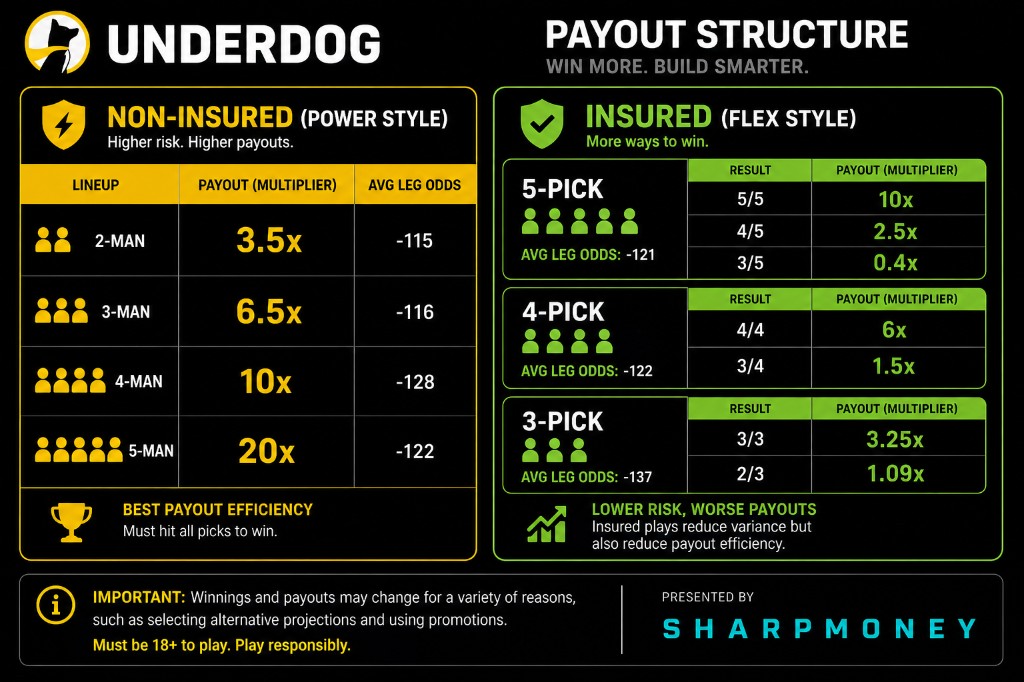
- Non-insured two-pick: highlighted as unusually strong — about a 3.5x payout in the example vs a lower multiplier ladder on two-pick PrizePicks, with average leg odds near −115.
- Default bias: prioritize two- or three-pick non-insured when you want traditional parlay-style payouts and the table agrees.
- Insured: Four- and five-pick insured can make sense when you want flex-style safety or promos/boosts that juice ROI on those shapes.
Takeaway: "I only play PrizePicks" vs "I only play Underdog" isn't cosmetic — you should mentally run different default slip recipes on each.
Other Books (and Why SharpMoney Lists Them Together)
The tool walkthrough mentions additional integrations (e.g. Sleeper, Dabble, DraftKings Pick6) with the same core idea: pick the payout preset that matches how you're actually building, then compare props against retail, sharp, and exchange prices.
SharpMoney DFS: Payout Presets + Strategies
Inside the app:
- Book selector + payout dropdown — mirrors the structures above (e.g. Underdog two-man non-insured at −115 average) so EV math matches what you're about to build.
- Handicapper plays — staff cappers publish edges; you can carry that opinion onto DFS books when the price still clears (e.g. "good to" line vs current DFS price).
- Pinnacle / "top-down" value — props priced weak vs a sharp reference.
- FanDuel-as-reference — useful on player props where the main line tracks sharper than pick 'em mirrors.
- Sharp book discrepancies — full-point (or more) gaps vs main lines at Tier-1 books.
- DFS book vs DFS book — niche markets (e.g. batting fantasy scores) where the same stat isn't apples-to-apples; the video example: an over on Underdog can pair with a higher line on PrizePicks when scoring rules favor hitters differently.
- Market blend — consensus retail pricing vs your DFS leg price.
- Exchange liquidity — large posted sizes on Novig / ProfitX-style venues treated as sharp opinion; compare to your −115-style DFS leg.
The UI also surfaces negative EV legs on purpose: in a parlay, a small negative leg paired with stronger edges can still yield a positive package EV — so hiding only "green" rows can mislead slip builders.
Execution: Building and Getting the Bet Down
The demo builds a five-pick PrizePicks flex, shows combined EV, and uses a one-click deep link where PrizePicks supports prefilled legs (Underdog often still needs manual entry). Filter settings let you hide books you don't use, trim strategies you don't trust, raise the minimum EV floor, and narrow to a sport.
Plans & Beta
SharpMoney DFS is live in beta on the Pro and Alpha packages — see the pricing page. We're polishing features and coverage; your feedback in Discord and under the YouTube video helps set priorities.
We're here for the same thing as the rest of SharpMoney: price, structure, and process — not vibes. Pair this guide with our +EV primer if terminology is new.
Key Takeaways
- Structure is half the battle — flex vs power (or insured vs non-insured) changes implied leg odds.
- PrizePicks: favor 5–6 pick flex; 3-pick power is workable; 2-pick power is usually structurally tax-heavy.
- Underdog: often leads with 2-pick (and 3-pick) non-insured; insured 4–5 for flex-style goals.
- Use average leg odds to compare ladders apples-to-apples.
- SharpMoney DFS bakes in book-specific payout presets plus multi-strategy scanning so you're not guessing.
Plans: SharpMoney pricing (DFS on Pro / Alpha). Confirm trial terms and promos on Whop at checkout; video description may list YouTube10 for 10% off your first month.